
No Moultrie 24-Hour Feed
Moultrie County does not publish a rolling 24-hour release list. The official sheriff site, its jail menu, county navigation, and the locally published Jail Report offer no released tab, last-day filter, discharge timestamp, or archive. A person seeking all Moultrie County Jail releases today cannot retrieve a complete set from one public webpage.
The nearest online source is the News•Progress Jail Report, maintained in partnership with the Sheriff's Department. It is a snapshot of the current population. Its date should be noted before comparing names, but the publisher states no update cycle. A name that disappears may reflect release, transfer, or another movement. It cannot establish the event by itself.
Check Moultrie Releases Today
Build a same-day timeline from the local custody source and the record that caused the movement. This method takes more than a feed, yet it distinguishes a true discharge from an IDOC commitment, another-county hold, or return to federal authority. Use the following order:
- Open the Jail Report and record its displayed date. Check whether the name is still present.
- Call Moultrie County Jail at 217-728-4386 and ask whether the person was discharged or transferred.
- Search the Moultrie Judici docket for a pretrial-release order, dismissal, sentence, mittimus, or later order.
- Use Illinois VINE for a registered custody-change alert.
- Request the sheriff's discharge time, authority, and destination when exact proof is needed.
The broader Moultrie County released-inmate search explains how to follow a named person into state, federal, or immigration custody. Each receiving system should be checked only when the local record points there.
Moultrie Same-Day Record Fields
Because no Moultrie County 24-hour list exists, separate the fields visible online from the fields that must be requested. The current report can help identify a person and a possible hold. The sheriff's final movement record supplies the release facts.
| Field | Where it appears | What it proves |
|---|---|---|
| Name, Date In | Current Jail Report | Presence in the dated snapshot, not release |
| Offense, Disposition | Current Jail Report | Charge context or a listed hold; not a completed movement |
| Discharge date and time | Sheriff release record | When Moultrie County custody ended |
| Release authority or reason | Sheriff record and court file | Why the movement occurred |
| Destination or receiving agency | Sheriff transfer record | Whether custody continued elsewhere |
Illinois FOIA section 2.15 supports requesting the time and date a person was discharged or transferred from an arresting agency's custody. It also covers specified arrest details and a photograph when available, subject to lawful limits and redaction.
Request Moultrie Release Proof
A focused county FOIA request is the durable fallback. Use the Moultrie County FOIA instructions and identify the person by full name plus date of birth or an approximate booking date. Name Moultrie County Jail and a narrow date range. Ask for intake and booking number, received time, discharge time, release authority, related court or case number, destination on transfer, and the booking photograph when available.
The county says an ordinary request is complied with or denied within five business days, with notice of a permitted extension of no more than five additional business days. The first 50 printed pages are free. Later black-and-white pages are $0.15 each, and color pages after the first 50 are $0.26 each. Electronic delivery may avoid copy charges. Exempt or confidential details can be redacted.
For a wider date check, the Moultrie County 72-hour release page explains how to build a three-day record without mistaking FOIA's arrest-information deadline for a release feed.
Moultrie Release or Transfer
“Released” from Moultrie County Jail means that sheriff custody ended. It does not always mean freedom from all custody. A court can order pretrial release, a sentence can end through time served, or a charge can be dismissed. The person can also leave under a mittimus commitment to IDOC, another county's warrant, a federal hold, treatment placement, or another authorized transfer.
| Situation | Best next source |
|---|---|
| Still shown on the current report | Jail for current local custody |
| Community discharge | Sheriff discharge event plus court order |
| Transfer to state prison | IDOC search after intake processing |
| Federal movement | Jail confirmation, then USMS or BOP as appropriate |
VINE can memorialize a custody change, but it is fed by the underlying agency. A missing result is not proof. Name spelling, timing, transfer, protected data, and retention can affect what appears.
Moultrie Jail Report Limits
The Moultrie Jail Report is distinctive because a local newspaper hosts it under a stated no-cost partnership with the Sheriff's Department. It is not a common jail-vendor portal. The report groups people described as convicted and not convicted, shows a dated capacity, and lists Name, Date In, Offense, and Disposition.
Those details can guide a follow-up. A disposition may mention a mittimus or another hold. Still, the page has no booking number, birth date, discharge reason, release time, photograph, recent-release selector, or archive. No cadence or retention term is stated.
The current Moultrie Jail Report source shows the local format:
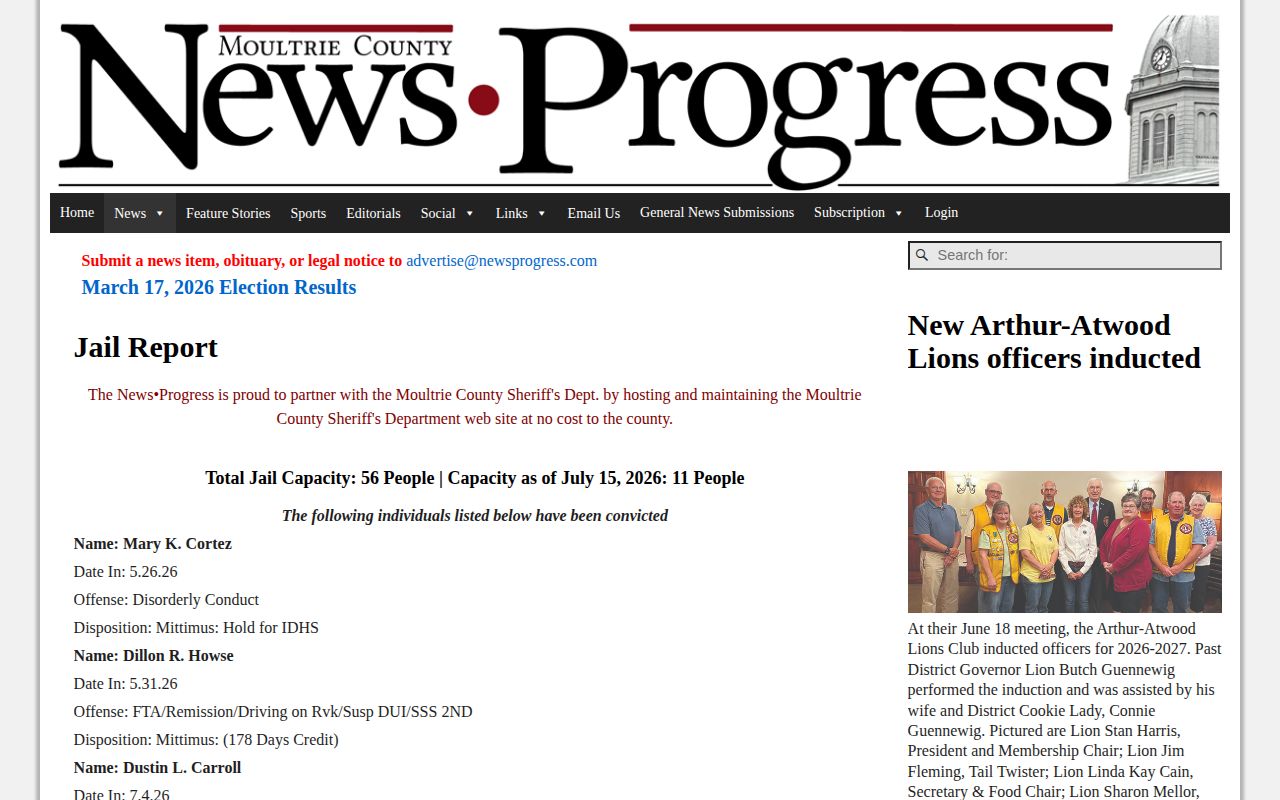
Its text-only custody snapshot explains why the final Moultrie County release record must come from the sheriff rather than a vanished roster entry.
Note: Record the displayed report date before calling, because the page does not claim real-time updates.
Moultrie Release Payment Scams
Moultrie County has a named Office of Statewide Pretrial Services contact at the courthouse. The agency states that its supervision and GPS services are free. It also warns that demands for payment for special “release” programs are scams. That warning is distinct from a valid amount or condition processed under a court order.
When someone claims money must be sent at once to secure a same-day release, verify the instruction through the court docket and an official office number. Do not treat a message, social post, or payment request as proof that Moultrie County Jail has approved discharge. A docket order supplies the legal basis; the sheriff record supplies the physical exit time.
Travel After Moultrie Release
Central Illinois Public Transit serves Moultrie County and recommends reserving one working day ahead. Same-day service depends on available space. Its published in-county fare is $3 one way or $6 round trip.
This is a planning option, not a verified pickup service at the jail gate. Confirm the person's destination, actual release time, pickup point, and ability to travel before relying on it. A transfer to IDOC, federal authority, or another county requires a different plan. Short processing delays can also make a same-day reservation impractical.
Property may require a separate follow-up. The county jail inspection checklist reviews itemized receipts and signed authorization when property goes to another person. Contact the jail with the receipt and ask what its actual record says. No universal Moultrie pickup place, time, or procedure is documented, so confirm the details rather than assuming that property leaves with every discharge or transfer.
A release-day plan should also account for the legal destination. Someone leaving after a court-ordered pretrial release may need to report to the Office of Statewide Pretrial Services. That is not probation or parole. Someone transferred under mittimus must be tracked through IDOC after intake. If another county or federal authority takes custody, contact that receiving system. The local discharge time remains useful because it fixes the end of Moultrie custody even when a second custody period begins at once.
Keep names, booking dates, case numbers, and alert times together. Similar names can cause a false match, and one timestamp may record an order while another records the physical exit. The best same-day finding joins the correct identity, the sheriff movement, and the legal authority. If those facts conflict, ask the office that created each record to clarify its own entry instead of forcing the sources into one unsupported conclusion.