
No Moultrie 72-Hour Feed
Moultrie County does not publish a rolling 72-hour release list. No three-day URL, released-person tab, date-window selector, or archive was found on the sheriff site, its jail menu, county navigation, or the locally hosted Jail Report. The absence matters around weekends, when a reader may hope one wider view will collect several days of jail exits.
The public Moultrie Jail Report instead shows a dated current-population snapshot. It has no discharge field and does not state its update schedule. Comparing snapshots can identify a name that disappeared, but cannot say when the movement occurred or whether the person entered another agency's custody.
Build a Moultrie Three-Day List
A three-day check works best as a date-bounded records task. Start with the local snapshot, then confirm each candidate through the office and court record that created the event.
- Save the Jail Report's displayed date and note who is currently listed.
- Call Moultrie County Jail at 217-728-4386 and ask whether a named person was discharged or transferred during the date range.
- Search Moultrie Judici for a release order, dismissal, sentence, or mittimus.
- Review a registered Illinois VINE alert for a custody-change event.
- File a narrow request for the sheriff's discharge time, reason, and destination.
The Moultrie 24-hour release check is better for a same-day question. It uses the same official sources but focuses on immediate verification and release-day logistics.
Moultrie Three-Day Release Fields
No online Moultrie County 72-hour list supplies release fields. The table separates the limited public snapshot from the requested record needed to assemble a sound three-day list.
| Field | Public report | Release-record value |
|---|---|---|
| Name and Date In | Shown | Identifies the booking |
| Offense and Disposition | Shown | Gives context, not proof of exit |
| Discharge date and time | Not shown | Places the exit within the 72-hour range |
| Release authority | Not shown | Explains why custody ended |
| Destination or transfer agency | Not shown | Separates community release from continued custody |
A booking number and related case number also help join the jail movement to the correct court file. Ask for both when a common name could produce a false match.
Moultrie Weekend Release Checks
A 72-hour range often crosses a weekend or county holiday. The sheriff's business office lists weekday hours of 8:00 a.m. to 4:00 p.m. and closes on county holidays, while the jail operates at all times. A custody movement can therefore occur when routine records help is not open.
Record the exact start and end of the period. Ask for events by discharge timestamp, not by the date when a webpage changed. Court processing, jail workflow, and a receiving agency's intake can create different timestamps for the same movement. A Monday roster comparison cannot reliably assign an absent name to Friday, Saturday, or Sunday.
For one named person, use the Moultrie County release search paths to follow the correct county, state, federal, or immigration system. The destination determines which locator can confirm the next status.
Request Three-Day Moultrie Records
Use the Moultrie County FOIA process when a complete or exact record is needed. Identify Moultrie County Jail, the precise three-day range, and the person by full name plus birth date or approximate booking date. Request the booking number, intake time, discharge time, release authority, case or order, and destination or receiving agency.
The county describes a five-business-day ordinary response period and a permitted extension of no more than five further business days with notice. The first 50 printed pages are free. Further black-and-white pages cost $0.15 each, while color pages after the first 50 cost $0.26 each. Electronic copies can reduce copying. Redactions and exemptions may apply.
Illinois VINE can provide a faster alert when registration occurred, but it is not the underlying discharge record. Likewise, IDOC search results apply to state custody, not to an ordinary county-jail community discharge.
Illinois 72-Hour Rule Explained
The “72 hours” in 5 ILCS 140/2.15 is not a mandate for a public webpage listing everyone released during the past three days. It is a deadline for furnishing specified chronologically maintained arrest information as soon as practical and no later than 72 hours after arrest.
That arrest information includes the person's name, age, address, charges, arrest facts, and a photograph when available. If the person is incarcerated, it also includes the time and date received into, discharged from, or transferred from the arresting agency's custody. The rule supports a request for Moultrie's discharge timestamp. It does not create a rolling release feed, override every exemption, or guarantee that one online roster contains the data.
Note: Measure the requested release window separately from the statute's arrest-based furnishing deadline.
Moultrie Roster Retention Limits
News•Progress hosts the report through a stated no-cost partnership with the Sheriff's Department. Its fields are Name, Date In, Offense, and Disposition, with convicted and not-convicted groupings and a dated capacity. No booking number, birth date, release reason, release timestamp, image, archive, or retention period appears.
The source report shows why it cannot be filtered into a Moultrie County 72-hour release list:
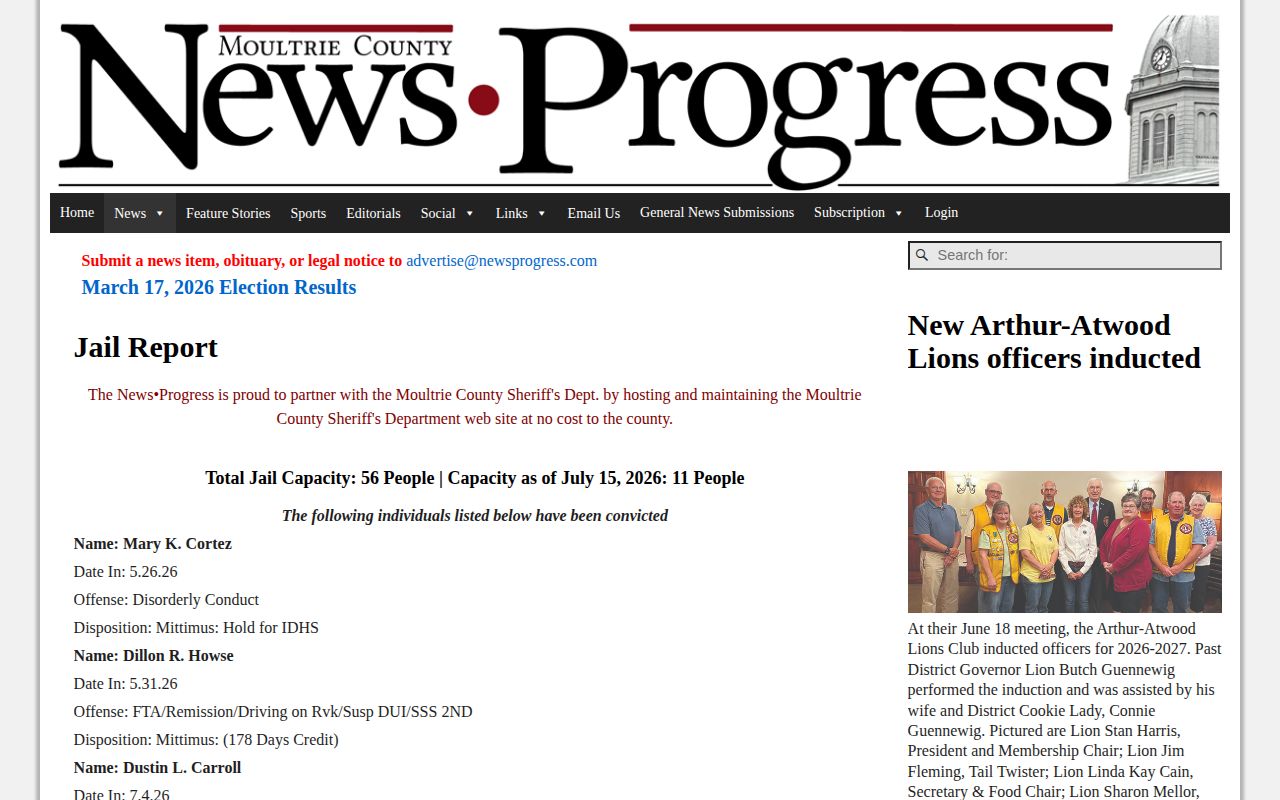
The dated roster is useful for current-custody context, but a later disappearance still requires the sheriff discharge record and destination check.
Moultrie Release Destinations
A three-day list must not collapse every jail exit into “released home.” Moultrie County Jail can discharge someone after a pretrial order, dismissal, time served, or sentence completion. It can also transfer someone under mittimus to IDOC, on another county's hold, or back to federal authority.
- Discharge
- The end of one agency's physical custody.
- Transfer
- A movement to another agency while custody continues.
- Mittimus
- A court commitment that may direct movement to a correctional authority.
- VINE event
- A notice derived from an agency feed, not the source record.
Request the destination field. Then confirm with IDOC after intake, the named county, or the appropriate federal system. A blank locator result can reflect processing lag or the wrong custody system.
The court file and custody record answer different questions. A pretrial order, dismissal, sentence, or mittimus explains the legal authority. The Moultrie sheriff's discharge entry identifies when jail staff completed the movement. Neither replaces the other when an exact three-day timeline matters.
For state custody, read an IDOC profile's status and institution with any projected parole or discharge date. A person on mandatory supervised release has left prison but has not completed the full sentence. For federal custody, a roster disappearance can mean return to USMS authority. A BOP result applies only after the person enters that system.
ICE presents another narrow route. Its locator can cover current detention and releases from ICE custody within 60 days, but it is not a Moultrie County jail archive. A local discharge on an immigration detainer may mark transfer into immigration custody. Confirm the sheriff destination first.
Use a simple event ledger for the three-day span. Record the source, the time shown, the event label, and the agency responsible for that entry. A court order time, VINE alert time, jail discharge time, and receiving-agency intake time can all differ without being wrong. The sequence is more useful than assuming one source updates every other system at once.
Older proof may outlast online visibility. The current report has no archive or published retention period, while the Circuit Clerk states that its public online case coverage begins in 1990. A completed IDOC profile can also leave the public offender search after final discharge. County FOIA, the clerk, or IDOC's archived-record route may therefore be needed even when every live name search is blank.
Ask narrowly. A request for all records about a person can draw material unrelated to the release question and may require more review. A request for the booking number, discharge timestamp, release authority, and destination within three named dates is easier to match to the desired event. If the county withholds a field, retain the written reason and use the review information provided with the response.